I have proposed that the deconstruction of taken for granted ways of thinking and being presents persons with options for the negotiation and renegotiation of their experience of life in terms of alternative modes of thought and practices of life. I have further proposed that this deconstruction frees persons to more actively monitor the real effects of their ways of being and thinking, and that this has the potential to provide them with the opportunity to have more to say about which ways they might live, and which ways they might think.Michael White, in Narratives of Therapists Lives
Showing posts with label quotes. Show all posts
Showing posts with label quotes. Show all posts
Thursday, December 8, 2011
renegotiating experience
I've been reading a book about Narrative practices, and this struck me tonight; I wanted to remember it.

Monday, November 28, 2011
more about mattering
Our deepest fear is not that we are inadequate.
Our deepest fear is that we are powerful beyond measure.
It is our light, not our darkness that most frightens us.
We ask ourselves, Who am I to be brilliant,
gorgeous, talented, fabulous?
Actually, who are you not to be?
You are a child of God.
Your playing small does not serve the world.
There is nothing enlightened about shrinking
so that other people won't feel insecure around you.
We are all meant to shine, as children do.
We were born to make manifest the glory of God that is within us.
It is not just in some of us; it is in everyone.
And as we let our own light shine, we unconsciously
give other people permission to do the same.
As we are liberated from our own fear,
our presence automatically liberates others.
- Marianne Williamson, in Return to Love: Reflections on a Course in Miracles
(I've also seen these words attributed to Nelson Mandela)
Sunday, November 20, 2011
be not ashamed
 |
| This is from Brene Brown's blog called Ordinary Courage. |
I think Brene is on to something here, and I think it looks - practically - like forgetting about fine china and hidden closets and just owning that whatever is behind us and within us all makes up one life. Trying to separate and be choosy about what gets seen is never going to be something other than incomplete and partial.
She hits the nail on the head - if we are only letting certain parts of ourselves and our stories matter, we are going to miss out on some of the best parts of human experience; love, belonging, joy .... probably some others, too. Or we're only getting a small glimpse of those experiences .... It's only by embracing the vulnerability of being our real, complete selves that we can hope to enter into the fullness of of being human.
Wednesday, September 14, 2011
Anyway
 |
| from http://ptskjohnson.blogspot.com |
I love these words from Mother Theresa.
I needed to be reminded of them today.
Maybe you did too?
Saturday, July 9, 2011
echoes, phantoms and expectations
Lately, I've been reading and thinking about gender roles/expectations. I came across some interesting stuff last week...
Virginia Woolf (1882-1941) was famous for writing, and later on for speaking up on behalf of women. (and maybe for being a bit unstable...) She expressed and embodied some of the struggle that was being experienced by the women (and men!) of her day. Rather than telling you my interpretation of the tension she lived with, here are some of her memoir words, from a lecture in 1931.
'I discovered that ... I should need to do battle with a certain phantom. And the phantom was a woman... I called her after the heroine of a famous poem,, 'The Angel in the House'.... you who come of a younger and happier generation may have not heard of her... I will describe her... She was intensely sympathetic. She was immensely charming. She was utterly unselfish. She excelled in the difficult arts of family life. She sacrificed herself daily. If there was chicken, she took the leg; if there was draught she sat in it - in short she was so constituted that she never had a mind or a wish of her own, but preferred to sympathize always with the minds and wishes of others. Above all - I need not say it - she was pure. Her purity was supposed to be her chief beauty, her blushes, her great grace. ... every house had its Angel ... the shadow of her wings (falls) on my page, I (hear) the rustle of her skirts in the room... (she whispers to me) 'my dear, you are a young woman ... be sympathetic; be tender; flatter; deceive; use all the arts and wiles of our sex. Never let anybody guess that you have a mind of your own. Above all, be pure'. ... I now record the one act for which I take some credit to myself ... I turned upon her and caught her by the throat. I did my best to kill her. My excuse, if I were to be had up in a court of law, would be that I acted in self defense. Had I not killed her she would have killed me ... for, as I found, you cannot put pen to paper .. without having a mind of your own, without expressing what you think to be the truth about human relations, morality, sex. And all these questions, according to the Angel in the House, cannot be dealt with freely and openly by women; they must charm, they must conciliate, they must .. tell lies if they are to succeed. Thus, whenever I felt the shadow of her wing or the radiance of her halo upon my page, I took up the inkpot and flung it at her. She died hard. Her fictitious nature was of great assistance to her. It is far harder to kill a phantom than a reality. She was always creeping back when I thought I had despatched her. - from Woolf's In the Death of the Moth and other Essays. As quoted by Daniel Levinson in Seasons of a Woman's Life.Even though we are living in a world that is very different from Woolf's 1931, I find myself wondering why is Woolf's phantom description still familiar?
Monday, January 31, 2011
from where we've come...
(a mailing list I subscribe to advised me of this today.. thought it was a good reminder for all of us...)

Did you know . . . January 28, marks 95 years since the Manitoba Legislature passed an amendment to the Manitoba Elections Act in 1916, giving most women in Manitoba the right to vote and run in provincial elections. Manitoba succeeded in being the first province in Canada to grant women suffrage. Women activists and their supporters spent many years dedicated to achieving this goal. In the years just prior to 1916, the movement for women’s suffrage in Manitoba was organized by the Manitoba Political Equality League, led by suffragette and political activist Nellie McClung and other noteworthy players, such as Cora Hind, Lillian Thomas, and Dr. Mary Crawford as well as many other dedicated women and men. The Manitoba Political Equality League coordinated the infamous “Women’s Parliament” a satire which turned the debate on its head and ridiculed the dangers of giving men the right to vote.
Importantly, not all women in Manitoba benefited from the 1916 amendment. It was not until 1952 that all Manitoba women gained the right to vote, when legislation changed so that Aboriginal men and women became eligible to vote in provincial elections and hold office without losing their treaty Indian status.
We look forward to a 100th anniversary celebration of this momentous event in 2016!
Monday, January 17, 2011
MLK
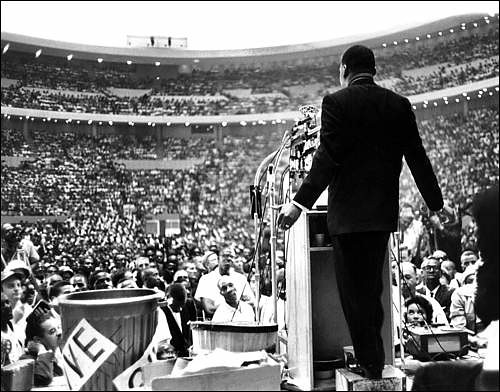
Martin Luther King Jr. Day is today.
Canadians join in appreciating and honouring the legacy of a man whose 'dream' contributed to very important change, and who became synonymous with courage and justice. When I think of Martin Luther King, I think of speaking up, of grace. I think of having the strength to act when rage and despair would be so inviting.
I think of honesty and reflection, shared responsibility.
I think of dignity, wisdom and leadership .... in action.
“In the End, we will remember not the words of our enemies, but the silence of our friends.”
“The ultimate tragedy is not the oppression and cruelty by the bad people but the silence over that by the good people.”
“Our lives begin to end the day we become silent about things that matter.”
 |
| With Rosa Parks - another grace filled person, even when she'd had enough |
Tuesday, October 5, 2010

Have you ever undertaken something thinking you understood it clearly, only to find out you'd really had no real clue of what you were getting yourself into?
That's my space as I learn more about becoming a counselor this week. I feel like a pretzel - twisted this way and that, turned inside out, and then prodded a little bit more just for some extra fun. It turns out that its me who is doing much of the examining and prodding, which feels even harder than if someone else were doing it.
The books we read make the practice of counseling seem straightforward and simple. In theory, I can do this. It seems easy! But the act of sitting with someone, even myself, in suffering and pain, sends me running, wanting to fix and cure, to apply the right method, to bring comfort at all costs.
As an exercise, we've been encouraged to pay attention to our inner dialogue, to reflect on what is happening within that causes us to act or react in certain ways. I have been doing that for several days now, and I don't know if my emotions have ever been so tired. I feel spent. A game of Twister might be a refreshing diversion right about now!
Are we willing to scrap the illusion of being experts who, if we can find and wield the proper methods, have the power to cure our clients and fix their maladies? - J. Olthuis, The Beautiful Risk
God created a reminder, an image. Humanity is a reminder of God. As God is compassionate, let humanity be compassionate. - Rabbi A.J. Heschel
Tuesday, June 1, 2010
a story to live in
This weekend, I got a chance to speak in church in anticipation of the Love Winnipeg 'caring for the core' initiative coming up.
As I was preparing, I remembered one of my textbooks referring to how we can approach the Bible as if we are mining for truth... but the truth we mine conforms to our pre-existing ideas/beliefs. Kind of like we find just what we're looking for, and new insights can be difficult to arrive at because of what we already believe or have been taught. I underlined that a few times, because it sounded like something I wanted to remember.
This morning, I was reading an essay by Eugene Peterson about the book of Romans.. talking about the apostle Paul, he says:
As I was preparing, I remembered one of my textbooks referring to how we can approach the Bible as if we are mining for truth... but the truth we mine conforms to our pre-existing ideas/beliefs. Kind of like we find just what we're looking for, and new insights can be difficult to arrive at because of what we already believe or have been taught. I underlined that a few times, because it sounded like something I wanted to remember.
This morning, I was reading an essay by Eugene Peterson about the book of Romans.. talking about the apostle Paul, he says:
"All his mental processes are subdued and submissive to what has been handed to him by revelation in Scripture. The words of scriptural revelation are the means by which he thinks and prays. Paul's relation to Scripture was not that of a student boning up for an exam, but that of a disciple of Jesus living the text. He spent the first part of his life as a Pharisee, using the scripture zealously, but wrongly. He spent the second part of his life as a Christian, living these same Scriptures just as zealously, but in a very different way. The difference was this: as an activist Pharisee, he used the Scriptures to support an angry crusade; as a believing Christian, he let the Spirit use the Scriptures to form Christ in him. The Scriptures furnish his vocabulary, shape his imagination, form his life.... it is not only that Paul quotes the Scriptures; he inhabits the story of Scripture... he gives the impression of being totally at ease with this richly expansive narrative of God's Word."
All this reminded me of one my friend Lisa's favorite passage; its in Psalm 119 (I know its one of her favorites because its often quoted on notes/cards I receive from her!) -
" Truly I love your commandments more than gold, more than fine gold. Truly I direct my steps by all your precepts. I hate every false way. Your decrees are wonderful; therefore my soul keeps them. The unfolding of your word gives light; and it imparts understanding to the simple." (vs 127-130)
Thursday, April 22, 2010
the church
Read Steve Bell's blog this morning... here is a quote about the church that struck me;
... Her flaws do not constitute her any more than mine constitute me, and I bet yours don’t constitute you either. It’s terribly important we own up to and amend for our weaknesses. But it’s also important we don’t allow them to define us ...
A good reminder for me.. I am often disillusioned with the church, yet I always love her deeply and feel pulled in the direction of defending and building her up.
Sunday, March 21, 2010


Tuesday, January 12, 2010
you have to check out this post...
i have been receiving info from Steve Bell's promo machine lately.
I sometimes read it, sometimes not. But i enjoy keeping tabs on steve, seeing as he's a native Winnipegger, lived in the North End, makes great music, and I just plain think he's cool :)
today's blog post is a must read. I mean it. Click here.
haven't clicked yet? here are a couple of excerpts...
I sometimes read it, sometimes not. But i enjoy keeping tabs on steve, seeing as he's a native Winnipegger, lived in the North End, makes great music, and I just plain think he's cool :)
today's blog post is a must read. I mean it. Click here.
haven't clicked yet? here are a couple of excerpts...
"Truth is indeed shy and remains obscured until it is teased out by the ones who really want to see – who patiently attend and show they will honour and cherish disclosure. Maybe that’s why truth is not easily found. We tend to lay claim on, commodify and then consume. No wonder we’re alienated from creation, from others, from ourselves. We’ve bought into the great western experiment based on the assumption that human nature is autonomous and self interested. Our politics, economics and infrastructures are based on this assumption."
... relating a long ago conversation with his Aboriginal foster daughter; “No,” she said,” I don’t mean that… I mean in commercials. There are never any Indians in commercials selling soap or cars or anything like that.” I was silent for a minute as I was trying to anticipate where she was going with this. “Nobody wants to see us do they?” She said sadly. I didn’t see that one coming. And I had no answer. We just sat in lonely silence until supper."
Read the whole post here... and thanks, Steve for food for thought.
Monday, November 30, 2009
Words
Do you love words? I adore words. I like words alone on a page, compiled in a story, spoken in prayer. I like words that build, words that describe, words that affirm. I think i especially like words that surprise. They're such useful things, words. Oh.. songs. words set to music. There are so many gifts to us through words and language, yes?
I am right now writing a paper on a fascinating book; Marva Dawn's 'Talking the Walk'. The reverse concept she's playing on with her title is of course Walking the Talk. I long for more rubber meeting road... more putting our money where our mouth is... Are you like me? - a little cynical of theory because of the absence of practice?
Marva's way of talking about the title and content of the book says this (among other things): 'during the last century, english speaking christians have been stressing that we should 'walk our talk'. -that our way of living should match the values that we espouse. That christians don't act on what they know and say is still a problem, for the passivity of wealthy societies keeps escalating.'
This wise author is a favorite of mine, and this isn't my first paper on one of her books. One of my great sadnesses is that I won't go to Regent and learn from her. Jess - are you taking anything from her?!
She says that she compiled the essays in this book because God is the point. Of Life. And somehow, using a language that isn't corrupted and stained, or made irrelevant, or overused and diluted, ... finding ways to redeem damage done - all this will help that fact (that God is the point) be better understood and more known.
She even refers to herself as a corrupter of God's name in the intro to the text. This resonates with where I dwell a lot these days:
I am right now writing a paper on a fascinating book; Marva Dawn's 'Talking the Walk'. The reverse concept she's playing on with her title is of course Walking the Talk. I long for more rubber meeting road... more putting our money where our mouth is... Are you like me? - a little cynical of theory because of the absence of practice?
Marva's way of talking about the title and content of the book says this (among other things): 'during the last century, english speaking christians have been stressing that we should 'walk our talk'. -that our way of living should match the values that we espouse. That christians don't act on what they know and say is still a problem, for the passivity of wealthy societies keeps escalating.'
This wise author is a favorite of mine, and this isn't my first paper on one of her books. One of my great sadnesses is that I won't go to Regent and learn from her. Jess - are you taking anything from her?!
She says that she compiled the essays in this book because God is the point. Of Life. And somehow, using a language that isn't corrupted and stained, or made irrelevant, or overused and diluted, ... finding ways to redeem damage done - all this will help that fact (that God is the point) be better understood and more known.
She even refers to herself as a corrupter of God's name in the intro to the text. This resonates with where I dwell a lot these days:
"I corrupt God's name still more by forgetting that every person I encounter bears God's image, that how I treat the passers-by and wheelchair pushers and janitors and military guards ... will reflect that corruption if I don't pay attention."
This post isn't only about a great book I'm reading and writing about. Its also a confession.
I have not honored words well in many, many conversations. I have resisted (and it was deliberate!) conforming my language to the 'churchy' expectations I encountered after becoming part of the Christian subculture. I became part of this culture because of a choice to re-orient away from self and towards Christ. i soon realized that not only was I converted to Christ, but also to this whole new expectation of how I should act.. right down to how I said things!!. I've stubbornly (there, I said it!) tried to be converted only to Jesus... not something else. (I think I was shocked to discover that Jesus actually opposed legalism.. so I vowed to oppose it too!)
But, today, as I read Marva's beatiful treatise about words, about liturgy, about their POWER and BEAUTY... I was converted. I am repentant about the way my language may have been corrupted (by whats in me) and contributed to corrupt interpretations. (about God) (Those abound, don't they? I don't have to support them any more than I already do just because I'm stubborn!)
Marva Dawn quotes Confucius who wanted to 'rectify names' as an approach to leadership. Lets be people of our word. Lets say what we mean and mean what we say.. and do nothing that brings our word into question.
Also, lets realize the far reaching implications of our words.. a hebrew term for 'word' is also used for 'event' - our words are powerful behavior shapers! They really do become actions...
Friday, October 23, 2009
reflections
Here are some thoughts from the day; I hope they inspire you as they have me:
- caring for the marginalized is not a marginal theme in scripture; its central. Being close to the oppressed and the poor isn't a trend or a bandwagon or a hobby. You can't be close from a distance or through charity.
- truth is revealed in community, not be detached experts
- are you an activist or a worshipper? Are you a fixer or a lover?
- "I'll take your charity and your money.. but I wish for you to know my name."
- NT Wrights defn of repentance: "Giving up my agenda for Christ's agenda"
- Society is individualized, fractured. This is not shalom.
- do you notice the brokeness, the messiness? Do you sense how illogical things are, how bizarre and countercultural? everywhere around you, in churches and on street corners? Do you feel that TENSION? (YES! I responded with head nodding emphatically) Well then, welcome to a life of following Christ. You better embrace that tension if you're going to pursue the things that matter to God over the long haul. You've gotta learn to live within that tension if you're not going to get burned out or bitter.
Saturday, October 10, 2009
the tension - not wanting 'me' to be more important than 'us'
Have you ever felt pulled in different directions? I have been wrestling lately. Who am I to believe something different than what I've been taught? Who am I to act in ways that haven't been modeled to me? Who am I to be different?
In class last week, we had this discussion about being 'neighbors'. A quote from an author named Rowan Williams was the centrepiece of the discussion;
This is a helpful idea for the counselling field; we must always be taking careful measures to avoid judging, assuming, not believing the best about clients. That's probably why this quote was highlighted for us. And it is a good reminder to not compete, criticize, or compare ourselves with others.
But for me, I had this picture in my mind of someone with a neighbor on either side, one neighbor needing mercy and love, the other neighbor full of condemnation and judgement for the needy neighbor. This idea illustrates the tension I feel each day as I observe situations and realities in the community I live in and as I reflect on the lack of understanding for this reality that I've always been surrounded with. What is the friend in the middle to do, how does s/he 'be a neighbor' to both neighbors? If s/he's only occupied with himself (or herself) and feels reluctant to address the harm being caused by the judging neighbor, is s/he really a neighbor to the needy neighbor? Or to either neighbor? If s/he does speak out, isn't s/he also judging? The outcome of the discussion with my classmates was that engaging with both neighbors in loving ways might lead to confronting the harm being done, and that this is indeed a neighborly pursuit. hmm. It was a lively conversation, one that got a lot of us thinking.
Just today, I re-read my last post and thought about how I might be saying something negative about my friend's family. I talked about how he jokingly referred to being taught to fear those different from himself. I was feeling bad because I didn't want to hurt or offend by being somewhat critical of teaching children to fear others. THAT is the tension, right there. I want to criticize our society (not my friend or his family), but a culture that says its okay to be fearful and protective at the expense of people and relationship. Its not okay! Its not okay to elevate 'me' over 'us'. And if you look around (with seeing eyes), you'll observe the hefty price being paid by many ... But at the same time, how can I be critical of anything when I have so many faults? How can any of us point fingers anywhere but at ourselves? And furthermore.. how do we go around pointing fingers at people and things that we are totally familiar and comfortable with? How do we change, how do we address the wrong we do each day and the ways that our own actions perpetuate and create the very things that we become so fearful of?
Sometimes, I leave posts at this point. I just ask questions, but don't offer anything else. Mostly because I usually have more questions than answers... but this time, I am going to push the envelope even further than I already have....
I'm gonna suggest that personal change is essential for all of us. We have to personally take responsibility for the ways we've judged, condemned, isolated, marginalized, oppressed, silenced, ignored, pushed aside ...... we have to take responsibility for the society we have created and the tremendous harm that is done all over the world because of our self involvement and complacency.
Structural changes can make a difference when personal changes have preceded them. They fall flat when they're expected to make a difference by themselves.
Could you take more responsibility for 'us'? That would be so good for community. That would be so good for the world.
But wanting to justify himself, he asked Jesus, ‘And who is my neighbour?’
Jesus replied, ‘A man was going down from Jerusalem to Jericho, and fell into the hands of robbers, who stripped him, beat him, and went away, leaving him half dead. Now by chance a priest was going down that road; and when he saw him, he passed by on the other side. So likewise a Levite, when he came to the place and saw him, passed by on the other side. But a Samaritan while travelling came near him; and when he saw him, he was moved with pity. He went to him and bandaged his wounds, having poured oil and wine on them. Then he put him on his own animal, brought him to an inn, and took care of him.
The next day he took out two denarii, gave them to the innkeeper, and said, “Take care of him; and when I come back, I will repay you whatever more you spend.”
Which of these three, do you think, was a neighbour to the man who fell into the hands of the robbers?’ He said, ‘The one who showed him mercy.’
Jesus said to him, ‘Go and do likewise.’
In class last week, we had this discussion about being 'neighbors'. A quote from an author named Rowan Williams was the centrepiece of the discussion;
"instead of being concerned about one's neighbor,
be occupied with one's own faults."
This is a helpful idea for the counselling field; we must always be taking careful measures to avoid judging, assuming, not believing the best about clients. That's probably why this quote was highlighted for us. And it is a good reminder to not compete, criticize, or compare ourselves with others.
But for me, I had this picture in my mind of someone with a neighbor on either side, one neighbor needing mercy and love, the other neighbor full of condemnation and judgement for the needy neighbor.
This idea illustrates the tension I feel each day as I observe situations and realities in the community I live in and as I reflect on the lack of understanding for this reality that I've always been surrounded with. What is the friend in the middle to do, how does s/he 'be a neighbor' to both neighbors? If s/he's only occupied with himself (or herself) and feels reluctant to address the harm being caused by the judging neighbor, is s/he really a neighbor to the needy neighbor? Or to either neighbor? If s/he does speak out, isn't s/he also judging? The outcome of the discussion with my classmates was that engaging with both neighbors in loving ways might lead to confronting the harm being done, and that this is indeed a neighborly pursuit. hmm. It was a lively conversation, one that got a lot of us thinking.Just today, I re-read my last post and thought about how I might be saying something negative about my friend's family. I talked about how he jokingly referred to being taught to fear those different from himself. I was feeling bad because I didn't want to hurt or offend by being somewhat critical of teaching children to fear others. THAT is the tension, right there. I want to criticize our society (not my friend or his family), but a culture that says its okay to be fearful and protective at the expense of people and relationship. Its not okay! Its not okay to elevate 'me' over 'us'. And if you look around (with seeing eyes), you'll observe the hefty price being paid by many ... But at the same time, how can I be critical of anything when I have so many faults? How can any of us point fingers anywhere but at ourselves? And furthermore.. how do we go around pointing fingers at people and things that we are totally familiar and comfortable with? How do we change, how do we address the wrong we do each day and the ways that our own actions perpetuate and create the very things that we become so fearful of?
Sometimes, I leave posts at this point. I just ask questions, but don't offer anything else. Mostly because I usually have more questions than answers... but this time, I am going to push the envelope even further than I already have....
I'm gonna suggest that personal change is essential for all of us. We have to personally take responsibility for the ways we've judged, condemned, isolated, marginalized, oppressed, silenced, ignored, pushed aside ...... we have to take responsibility for the society we have created and the tremendous harm that is done all over the world because of our self involvement and complacency.
Structural changes can make a difference when personal changes have preceded them. They fall flat when they're expected to make a difference by themselves.
Could you take more responsibility for 'us'? That would be so good for community. That would be so good for the world.
The Parable of the Good Samaritan
Just then a lawyer stood up to test Jesus. ‘Teacher,’ he said, ‘what must I do to inherit eternal life?’ He said to him, ‘What is written in the law? What do you read there?’ He answered, ‘You shall love the Lord your God with all your heart, and with all your soul, and with all your strength, and with all your mind; and your neighbour as yourself.’ And he said to him, ‘You have given the right answer; do this, and you will live.’But wanting to justify himself, he asked Jesus, ‘And who is my neighbour?’
Jesus replied, ‘A man was going down from Jerusalem to Jericho, and fell into the hands of robbers, who stripped him, beat him, and went away, leaving him half dead. Now by chance a priest was going down that road; and when he saw him, he passed by on the other side. So likewise a Levite, when he came to the place and saw him, passed by on the other side. But a Samaritan while travelling came near him; and when he saw him, he was moved with pity. He went to him and bandaged his wounds, having poured oil and wine on them. Then he put him on his own animal, brought him to an inn, and took care of him.
The next day he took out two denarii, gave them to the innkeeper, and said, “Take care of him; and when I come back, I will repay you whatever more you spend.”
Which of these three, do you think, was a neighbour to the man who fell into the hands of the robbers?’ He said, ‘The one who showed him mercy.’
Jesus said to him, ‘Go and do likewise.’
Friday, July 31, 2009
thoughts about courage
This article about Jimmy Carter was rolling around in my thoughts for a few days last week. It refers to Jimmy's public decision to separate himself from the denomination he was associated with in order to support a position that he has decided is 'bigger' than this affiliation. It quotes from a letter he wrote explaining his decision.
I read the article, and was surprised by what stayed with me. (you should too if this post is going to make any sense to you, and while you're at it, you could get more details about the Elders and a variety of interesting (mostly female) perspectives here.)
.... What stayed with me wasn't the emphasis on women's issues, although that is an important topic. I was interested in the idea that our treatment of women in the North American church is at all tied to how women are treated in other contexts all over the globe. This is a valid connection that I want to think and learn more about.
.... Nor was it the fact that I completely identified with Jimmy's position about the questionable conclusions in scripture about female roles:
I read the article, and was surprised by what stayed with me. (you should too if this post is going to make any sense to you, and while you're at it, you could get more details about the Elders and a variety of interesting (mostly female) perspectives here.)
.... What stayed with me wasn't the emphasis on women's issues, although that is an important topic. I was interested in the idea that our treatment of women in the North American church is at all tied to how women are treated in other contexts all over the globe. This is a valid connection that I want to think and learn more about.
.... Nor was it the fact that I completely identified with Jimmy's position about the questionable conclusions in scripture about female roles:
"The carefully selected verses found in the Holy Scriptures to justify
the superiority of men owe more to time and place -
and the determination of male leaders to hold onto their influence -
than eternal truths. Similar biblical excerpts could be found to
support the approval of slavery and the timid acquiescence
to oppressive rulers."
I hear shades of many conversations I've had in that excerpt! I also hear shades the oft-quoted Rich Mullins:
"You guys are all into that born again thing,
which is great. We do need to be born again,
since Jesus said that to a guy named Nicodemus.
But if you tell me I have to be born again to
enter the kingdom of God, I can tell you that you just have to sell
everything you have and give it to the poor,
because Jesus said that to one guy too…
[And he paused in the awkward silence.]
But I guess that’s why God invented highlighters,
so we can highlight the parts we like and ignore the rest."
... It also wasn't because I learned about the Elders, which seems like a grand idea. What a concept.. using one's influence to ... INFLUENCE!
No, what ended up staying with me was appreciation for Jimmy's courage. Dare I say that he had bal... okay, I won't finish that statement, it might be crude. (and I'm NEVER crude.)
At the end of the day, he had the courage to stand up for something that he believed was important.
He had the courage to separate himself - generously, graciously, kindly, but also assertively and with authenticity - from something that he believed was more harmful than helpful. He didn't slink away quietly and retreat until everything blew over. He didn't gloss over the truth of why he was reconsidering his alignment. He was just plain courageous. He was just plain honest.
Maybe we should be asking why that is so very inspiring and refreshing.....
Friday, June 5, 2009
Addiction?
“I am not being flippant when I say that all of us suffer from addiction. Nor am I reducing the meaning of addiction. I mean in all truth that the psychological, neurological, and spiritual dynamics of full-fledged addiction are actively at work within every human being. The same processes that are responsible for addiction to alcohol and narcotics are also responsible for addiction to ideas, work, relationships, power, moods, fantasies, and an endless variety of other things. We are all addicts in every sense of the word.”
This quote comes from a book I'm reading called Addiction and Grace, written by Gerald May. By Sunday night, I have to write a reflection on those words.. in preparation for Monday's mod. week. I'm on the way to being done already ... but I'm still very interested in the response this quote elicits in you folks reading. What do you think? Is this a narrow understanding of addiction? Or an accurate picture of humanity? Or perhaps just our society? I've asked a few of you in conversation and the response I've already heard is intriguing enough to make me curious to hear more of your thoughts.
Thursday, May 28, 2009
jungism
Anyone who wants to know the human psyche will learn next to nothing from experimental psychology. He would be better advised to abandon exact science, put away his scholar's gown, bid farewell to his study, and wander with human heart throughout the world. There in the horrors of prisons, lunatic asylums and hospitals, in drab suburban pubs, in brothels and gambling-hells, in the salons of the elegant, the Stock Exchanges, socialist meetings, churches, revivalist gatherings and ecstatic sects, through love and hate, through the experience of passion in every form in his own body, he would reap richer stores of knowledge than text-books a foot thick could give him, and he will know how to doctor the sick with a real knowledge of the human soul.
Carl Jung

Subscribe to:
Posts (Atom)